Verification for
Large-Scale Cold Ends.
Wet-cooled power stations are where TES was born. We bridge the gap between complex chemistry and station-ready performance metrics to evaluate MW capacity losses linked to condenser fouling.
Cold-End Optimisation.
TES is primarily designed for wet-cooled coal and gas units where the condenser is a primary source of efficiency loss.
Condenser Performance
Stabilise TR and TTD values by keeping condenser tubes free of biofouling and scale.
Make-up Integrity
Maintain system efficiency even as make-up water quality (dam/mine water) fluctuates.
MW Impact Review
Review whether cleaner surfaces correspond with measurable improvements in unit heat rate.
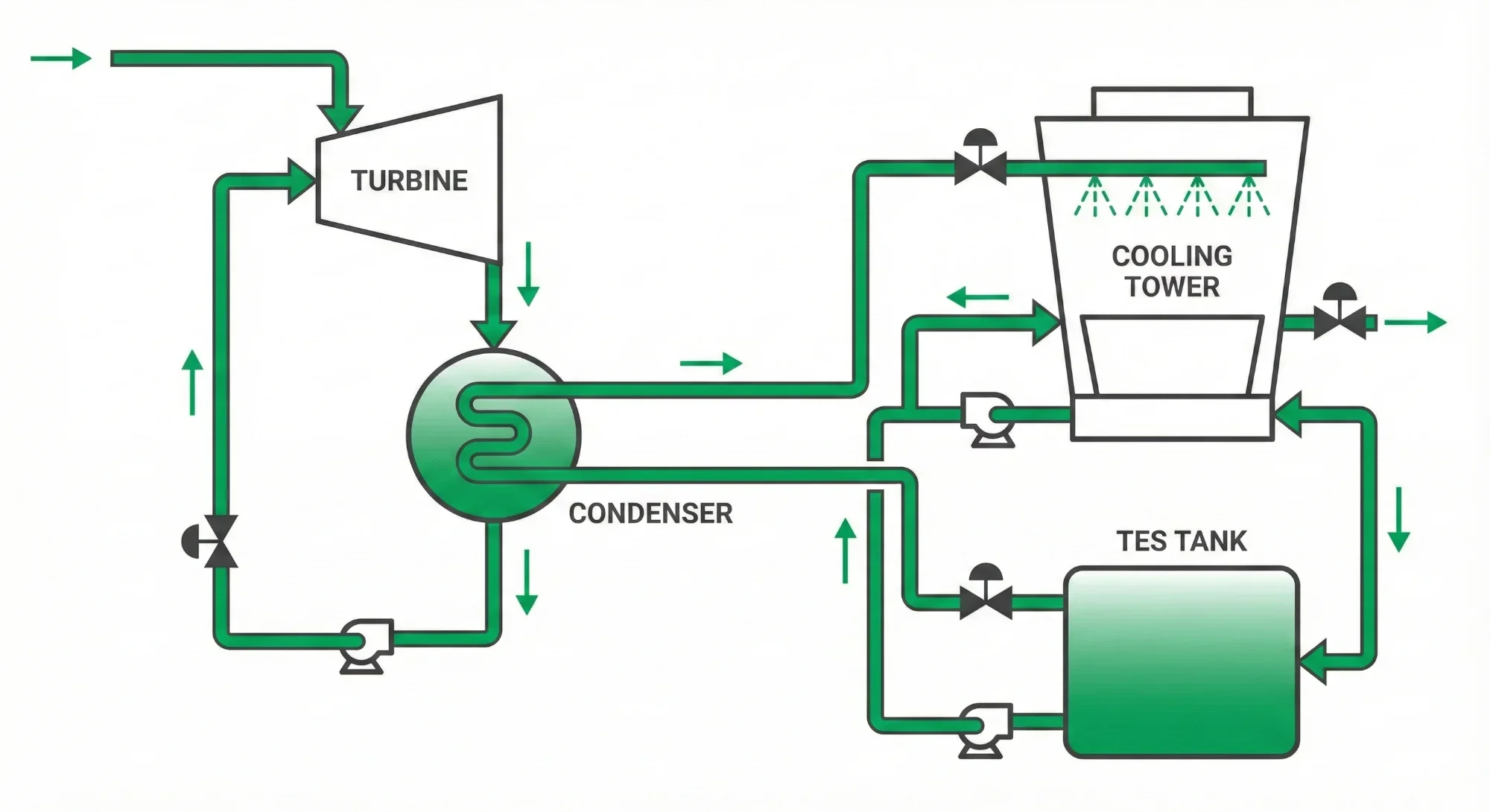
Condenser & Tower Circuit
Stable Cold-End Performance.
By maintaining the surface interface with Mexel®432, TES is intended to reduce the biological blanketing that causes the secondary baseline to drift from design capacity. The operational value is reviewed against matched-load data, inspection evidence and the site's existing condenser-cleaning regime.
Emissions Methodology Review
Efficiency improvements at wet-cooled power stations may support derived emissions calculations. Working with Brundtland Consulting, we can help clients assess whether verified thermal-efficiency data is suitable for a later VCS or DFFE methodology pathway.
ASME PTC 12.2-aligned analysis can review heat-rate impact via TTD/TR. CO₂ impact remains a derived, project-specific calculation requiring separate validation.
Start Your Thermal Baseline Review.
The first step in any TES implementation is a disciplined primary → secondary baseline. Connect with our engineering team to begin the process.