Verification for
Large-Scale Cold Ends.
Wet-cooled power stations are where TES was born. We bridge the gap between complex chemistry and station-ready performance metrics to restore MW capacity lost to condenser fouling.
Cold-End Optimisation.
TES is primarily designed for wet-cooled coal and gas units where the condenser is a primary source of efficiency loss.
Condenser Performance
Stabilise TR and TTD values by keeping condenser tubes free of biofouling and scale.
Make-up Integrity
Maintain system efficiency even as make-up water quality (dam/mine water) fluctuates.
MW Restoration
Directly link cleaner surfaces to measurable improvements in unit heat rate.
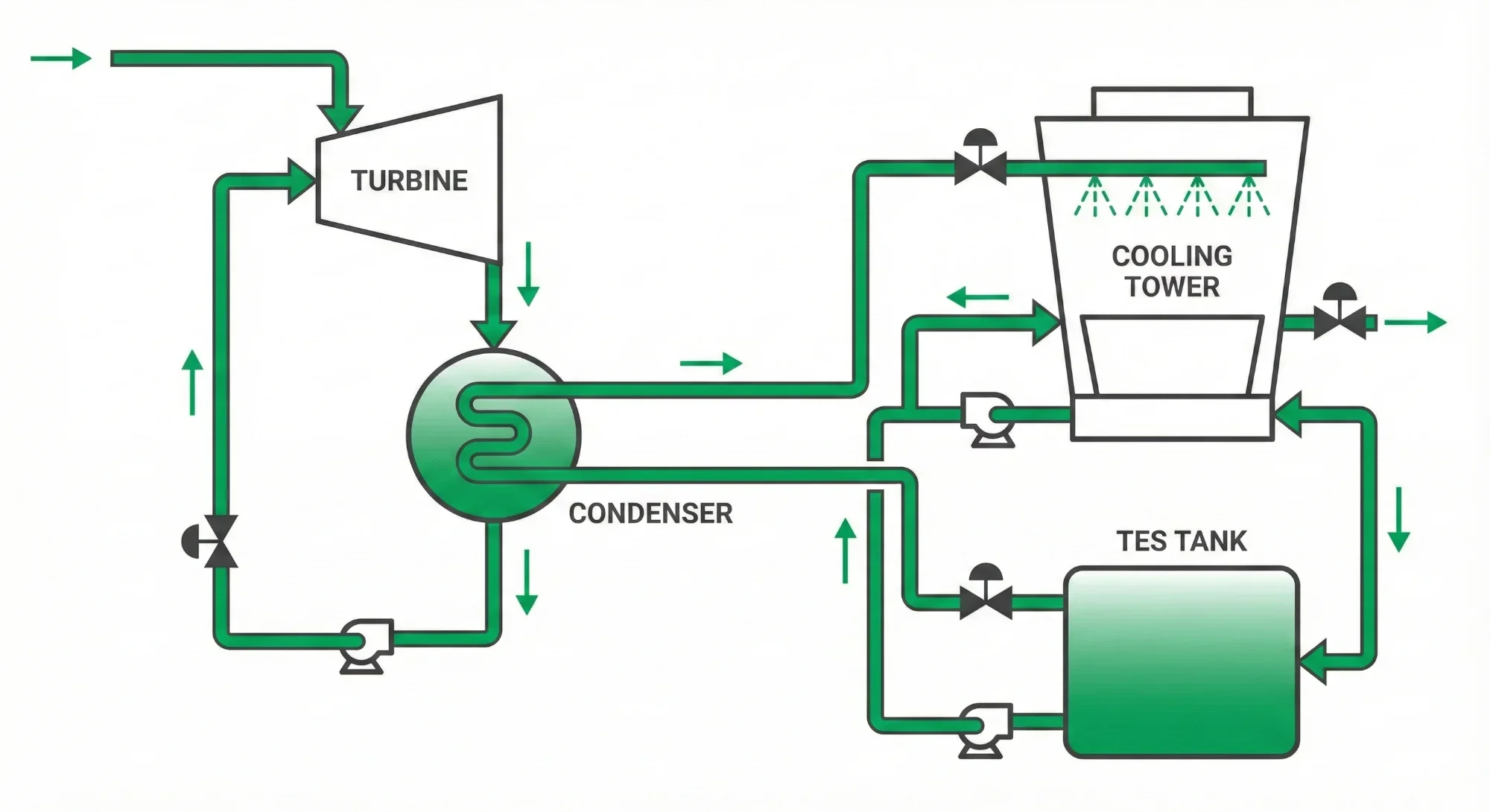
Condenser & Tower Circuit
Uninterrupted MW Generation.
By maintaining the surface interface with Mexel®432, we prevent the biological blanketing that causes the secondary baseline to drift from design capacity. This ensures that your unit can meet its full load profile throughout the summer peak without requiring manual condenser cleaning outages.
Carbon Credit Revenue Opportunity
Efficiency improvements at wet-cooled power stations deliver measurable emissions reductions. Working with Brundtland Consulting, we help clients navigate VCS methodology and develop carbon credit projects from verified thermal efficiency gains.
ASME PTC 12.2 verification provides the audit-grade documentation required for carbon credit registration under South African (DFFE) and international (VCS) frameworks.
Start Your Thermal Baseline Review.
The first step in any TES implementation is a disciplined primary → secondary baseline. Connect with our engineering team to begin the process.